1. Front Matter
Title: xAPI Export and Tracking Integration
Author: Jethro Magdaleno Lagmay
Reviewers: James Derrick Billate
Creation Date: June 6, 2026
Status: Draft
2. Introduction & Goals
Problem Summary: Historically, WyzQuests supported only SCORM 1.2 and SCORM 2004 for course exports. However, modern Learning Record Stores (LRS) and LMS environments rely on xAPI (Tin Can) to capture granular, event-driven learner data. This feature introduces xAPI export capabilities, allowing creators to generate tincan.xml compliant packages and enabling the WyzQuests player to fire real-time JSON statements to an external LRS when a learner interacts with decision nodes.
Goals & Non-Goals:
Goals:
Enable generation of a valid xAPI
.zippackage with atincan.xmlmanifest.Capture dynamic LMS credentials (endpoint, auth, actor) passed via URL parameters and inject them into the
QuestPlayeriframe.Fire asynchronous xAPI
answeredstatements when a learner selects a choice in a Decision Node.Separate SCORM and xAPI backend architectures for maintainability.
Non-Goals:
Building an internal LRS within WyzQuests.
Tracking non-decision interactions (e.g., time spent on a single page, scrolling).
Implementing the full cmi5 specification.
Glossary:
xAPI (Experience API / Tin Can): An e-learning software specification that allows learning content and learning systems to speak to each other.
LRS (Learning Record Store): The system that receives, stores, and returns xAPI statements.
Statement: The JSON payload formatted as "Actor -> Verb -> Object" (e.g., "John Doe answered Scenario 1").
3. High-Level Architecture
System Diagram:
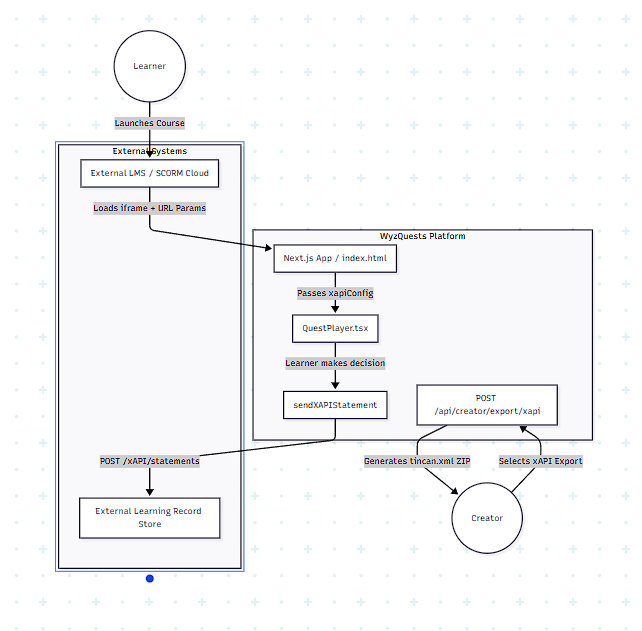
Technologies Used:
React / Next.js
jszip(for dynamic package generation)Standard Web APIs (Fetch, URLSearchParams)
4. Detailed Design & Implementation
Data Model / Schema: No new database tables were required. Export constants were centralized to avoid hardcoding:
XAPI_EXPORTandSCORM_EXPORTimplemented viaconstants/export.ts.
API Specification:
Endpoint:
POST /api/creator/export/xapiDescription: Generates the xAPI zip package. Does not log to Supabase.
Request Body: ```json { "questId": "string", "version": "xapi" }
Response:
application/zipcontainingindex.htmlandtincan.xml.
Logic & Workflows:
Frontend Export Modal (
Export.tsx): Conditionally hides the "Mastery Score" input ifxAPIis selected, as xAPI tracking relies on granular node decisions rather than a single passing score. Routes the request to/api/creator/export/xapiinstead of the Single-SCO route.Manifest Generation: The route utilizes
generateTinCanManifest()fromlib/export/templates/xapiManifest.tsto build the required XML structure, omitting standard SCORM JavaScript wrappers.Event Tracking (
QuestPlayer.tsx): ThehandleChoiceSelectwrapper captures the selected choice ID. It safely maps the choice text and node title against the existing TypeScript interfaces (currentChild,choices) and dispatches the payload using theXAPI_VERBS.answeredconstant.
5. Infrastructure & Operations
Dependencies:
This feature strictly relies on the host LMS/LRS to provide valid
endpoint,auth, andactorparameters. If these are missing, theQuestPlayerfails silently by design, allowing the visual canvas to continue functioning without tracking.
Monitoring & Alerting:
Backend export failures will be caught and returned as standard 400/500 JSON responses or bubble up to the global error handler.
Failed xAPI fetch requests to the external LRS are caught in the client-side
try/catchblock within thesendXAPIStatementwrapper to prevent blocking the UI thread.
Deployment Plan:
Standard merge to
main. No database migrations or feature flags are required as this extends the existing export functionality.
6. Testing & Quality Assurance
Test Strategy:
End-to-End Testing: Conducted via SCORM Cloud.
Localhost environment tunneled via
ngrok(required as SCORM Cloud blocks non-HTTPS iframes).xAPI
.zipexported using the Ngrok origin.Package launched in SCORM Cloud.
Verified that UI node interactions dynamically populate the SCORM Cloud LRS Statement Viewer in real-time with valid JSON payloads.
Known Limitations:
Because WyzQuests relies on an iframe strategy, testing strictly requires HTTPS tunneling (like Ngrok) when interfacing with strict modern LMS platforms.
Mastery score is intentionally excluded from the xAPI package; teams requiring a strict pass/fail gate should use the SCORM 2004 export.
7. Maintenance & Support
Troubleshooting:
Issue: "Statements are not appearing in the LRS."
Resolution: Inspect the Network tab in the browser. Verify the LMS is correctly appending
?endpoint=...&auth=...&actor=...to the launch URL. If thexapiConfigobject inQuestPlayeris missing these, the statements will not fire.
Issue: "Export fails with 400 Bad Request."
Resolution: Verify the frontend is passing
version: "xapi"to the isolated/api/creator/export/xapiroute, not the legacy SCORM route.
Changelog:
1.0 - Draft, Feature pushed to dev server after initial dev review, 06/06/2026
