1. Front Matter
Title: AI Idea Validator
Author: Sean Patrick Caintic (scorevi)
Reviewers: Joshua Tribiana Uriel, Krizha Onise Cortez (Joshua-Yel, armaminter)
Created: February - March 2026
Status: Approved
References:
Issue: [1.2] AI Idea Validator #24
Milestone: [1] Diagnose (Project Setup)
2. Introduction & Goals
Problem Summary: Creators need a way to validate their quest topics before investing time in content creation. The AI Idea Validator is a Gemini-powered system that assesses topic viability and generates structured curriculum outlines including conflict points, crisis scenarios, and recommendations—all importable into the Visual Canvas editor.
Goals:
Provide AI-powered topic validation with viability scoring (0-100)
Generate structured curriculum outlines with modules
Identify conflict points and crisis scenarios for engagement
Enable direct import of AI output to Visual Canvas
Cache responses to reduce redundant API calls
Implement content safety filtering
Non-Goals:
Real-time content generation during quest editing
AI-generated media assets (images, videos)
Automatic quest publishing without creator review
Glossary:
Viability Score: 0-100 rating of topic's educational potential
Curriculum Module: A unit of learning content with duration estimate
Conflict Point: Branching decision point for learner engagement
Crisis Scenario: Assessment activity placed after specific modules
Canvas Metadata: React Flow nodes/edges JSON structure
3. High-Level Architecture
System Diagram:
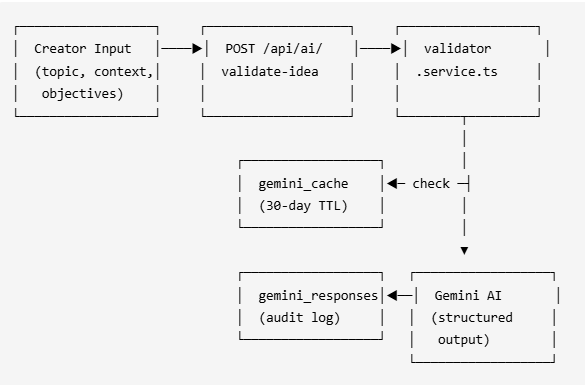
Data Flow: Input → Zod validation → Content safety check → Cache check → (miss) Gemini call → Parse structured JSON → Save response log → Save to idea_validations → Return result.
Technologies Used:
Google Gemini Pro - AI topic validation and curriculum generation
Zod - Input/output schema validation
Supabase - Data persistence and caching
Clerk - Authentication (creator role)
React Flow - Canvas node conversion
4. Detailed Design & Implementation
Data Model / Schema:
idea_validations Table:
Column | Type | Description |
|---|---|---|
| UUID PK | Auto-generated |
| TEXT | Clerk user ID |
| TEXT | Original input topic |
| TEXT | Optional context |
| TEXT | Optional objectives |
| INT | 0-100 score |
| TEXT | AI reasoning |
| JSONB | Array of modules |
| JSONB | Array of conflicts |
| JSONB | Array of crises |
| JSONB | Array of strings |
| TEXT | Gemini model used |
| TEXT |
|
| TIMESTAMPTZ | Auto-timestamp |
Supporting Tables:
gemini_cache- Response cache with 30-day TTLgemini_responses- Full audit log of all AI callsgemini_api_logs- Per-request usage and quota trackinggemini_pricing- Model pricing configurationgemini_config- Admin model configurationAPI Specification:
POST /api/ai/validate-idea- Validate topic and generate curriculumRequest:
{ topic: string (2-200 chars, required), context: string (max 2000), learningObjectives: string (max 2000), bypassCache: boolean, questMode: "linear" | "exploration" }Response:
{ success: true, data: { viabilityScore, viabilityRationale, curriculumOutline, conflictPoints, crisisScenarios, recommendations }, error: null }
GET /api/ai/idea-validations- Get creator's validation historyGET /api/ai/active-model- Get active Gemini model info
Error Codes:
400 - Bad input / malformed JSON
401 - Unauthorized / not authenticated
422 - Content policy violation
429 - Rate limit exceeded
500 - AI parse failure / server error
504 - Timeout
Logic & Workflows:
Validation Flow:
Creator submits topic, context, and objectives
Zod validates input schema
Content safety layer filters (local + AI)
Cache check (SHA-256 key hash)
On miss: Gemini API call with structured output
Parse and validate response against output schema
Save to
idea_validationsandgemini_responsesReturn validated result
Curriculum-to-Canvas Conversion:
Start node (green) → Entry point
Curriculum Module →
quest-cardcontent cardConflict Point →
decisiondiamond for branchingCrisis Scenario →
activityassessment activityEnd node (red) → Completion point
Content Safety Layers:
Layer 1 (Local): Zero-latency regex filter in Zod
superRefineLayer 2 (AI): Gemini contextual analysis with evasion detection
Key Files:
app/api/ai/validate-idea/route.ts- Main API endpointshared/schemas/ai-validator.schema.ts- Zod schemaslib/ai/api-key-manager.ts- Gemini key managementlib/ai/cache.service.ts- Response cachinglib/ai/content-safety.service.ts- Safety filteringlib/utils/curriculum-to-canvas.ts- Canvas convertercomponents/creator/AIValidator.tsx- Main UI component
5. Infrastructure & Operations
Dependencies:
Google Gemini Pro - AI inference
Supabase - Data persistence, caching
Clerk - Authentication
Monitoring & Alerting:
gemini_api_logstracks per-request usage and quotaCircuit breaker: 3 consecutive AI failures → 5-minute local filter fallback
Response logger dual-sink: Supabase + local JSONL backup
Deployment Plan:
Run database migrations for all tables
Configure Gemini API keys in environment
Deploy API routes and UI components
Verify cache and logging functionality
6. Testing & Quality Assurance
Test Strategy:
Unit: Validator service (7 tests, mocked Gemini)
Integration: Real API calls (5 tests)
Structural: Request/response validation (~20 tests)
Unit: Content safety Zod integration
Unit: Local regex filter
Known Limitations:
Gemini response quality varies by topic complexity
Cache invalidation is TTL-based only (no manual purge)
Content safety may have false positives on edge cases
7. Maintenance & Support
Troubleshooting:
422 Content Policy Error → Topic triggered safety filter; rephrase input
504 Timeout → Gemini overloaded; retry or bypass cache
Cache not updating → Check
gemini_cacheTTL; usebypassCache: trueEmpty curriculum → Topic too narrow; add more context
Changelog:
1.0 (Feb 2026): Initial implementation
1.1 (Feb 2026): Added Quest Mode support (#285)
1.2 (Feb 2026): Smart Merge & Error Feedback (#245)
Document Version
1.0 - Initial version, 2026-04-27 07:58 UTC
1.0.1 - Minor revisions, 2026-04-27 07:59 UTC
1.0.2 - Minor revisions, 2026-04-28 06:18 UTC
1.0.3 - Minor revisions, 2026-06-29 07:45 UTC
1.0.4 - Minor revisions, 2026-06-29 07:47 UTC
1.0.5 - Minor revisions, 2026-06-29 09:09 UTC